
Is not true that, in this world, before being paper citizens we are our mother’s sons in the flesh. What is a human being in reality? To start from the beginning: What are peoples, cultures and what are then custom-houses, parliaments and states? Everybody carries a nursery rhyme in the soul, but nobody carries a passport or a custom-house in the soul.
Joxe Azurmendi, Basque writer and philosopher
The beginning of the new millennium carried a hope in the borderless online world, technology promised to be in the service of all, and the networked knowledge society, we believed, was within reach. But the reality of the second decade left little space for millennial utopias. Let us admit, our society has never been more divided, economic migration had not contributed to the rise of multiculturalism, waves of refugees from Africa and Middle East have transformed Europe into a place of infinite tragedy, and the key words shaping our social horizon are alternative facts and post-truth. The photographic series thematically bound by the term “New Citizen” were created precisely out of the need to perceive and understand our world for what it is, and to find ways and courage to transform it or to create new, more just communities of equal citizens around the world. Undoubtedly, late capitalism has changed the geopolitical, cultural and social horizon. The Mediterranean used to be considered the cradle of Western European civilization, a traditional meeting point of cultures, but the 21st century imposed on it the tragic role of the tomb of millions of refugees entering Europe in search of a more dignified life. The European continent, once celebrated as a torchbearer of progressive ideas and beliefs, is being transformed into a fortress of walls, barbed wire and growing social injustice, which is piercingly accurately depicted by Nick Hannes in his series “Mediterranean: The Continuity of Man”. The joy of meeting strangers, the pleasure of discovering new countries and cultures, or uncovering interconnectedness regardless of people’s origins are the starting points of Ingvar Kenne‘s photographic journey entitled “Citizens” that had begun in Canada in 1994 and ended this year in Thailand. A culture untouched by the idea of progress is the central topic of John Feely‘s research. His series entitled “The Outsider” reveals a culture that is shut out from the globalized world, enjoying a harmonious austerity of peripheral civilization positions.
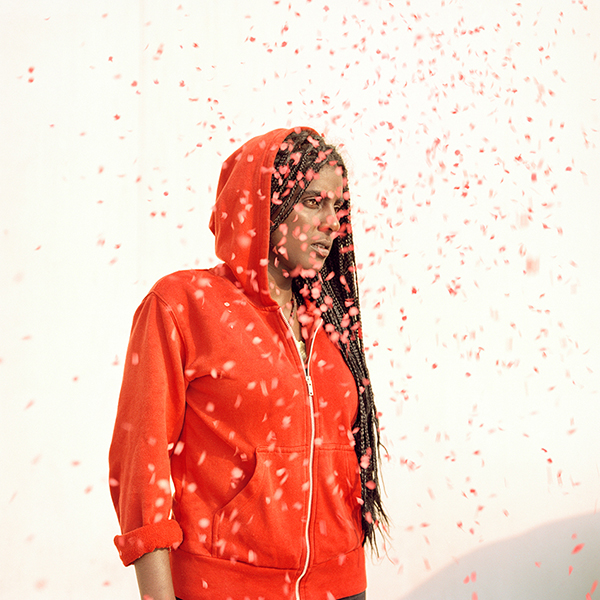
Alexandra Polina‘s series “Mask, Myths and Subjects” poetically deconstructs myths about “visible minorities”, citizens who were born, raised and live in Germany. The expected photographic mode of presentation is undermined by a kind of visual “virus”, photographs that introduce disruption into the expected portrait presentation, and the artist uses it to subvert stereotypes which uphold the widely accepted opinion about minorities. Minorities are also at the center of Miia Autio‘s “Variation of White”, a series of negative images, portraits of people of colour with albinism who are stigmatized because of their genetic disorder. The portraits reveal a twofold “otherness” of the subjects thanks to a red dot: a reflection of the original image can be seen by looking at the dot for 30 seconds and then looking at a white wall.
In her series “Zukunft” (“Future”), Sarah Pabst heals transgenerational cumulative trauma related to the rise of Nazism in Germany and involvement of family members in war events. The narratively fragmented photographic set-up points to confronting the fiction of national identity and self-identity processes projected through family memory. Remembrance and various memory registers are also the starting point of Annalise Natali Murri‘s series “La Nieve y La Flor”, which is an almost intimate witness to the emotional relationships arising from nowadays unthinkable, but once close unions of women from the Soviet Union and Cuban men. Personal and collective memories intertwine in this story about “love migration”, calling into question the traditional concept of belonging, at the same time promoting hybrid cultures.
In the series “Grinders” Hannes Wiedemann photographs communities that are springing up in small towns all over the US and who are fascinated with merging the human body with technological gadgets. The photographed subjects are promoting the idea of prosthesis, not by defining the body as post-technological, but as always already technological. In their experiments, not only does technology become part of the body, but the body itself is a form of technology. Drew Nikonowicz‘s series “This World and Others Like It” thematises the role of the researcher in the 21st century by combining contemporary technologies and analogue photography. More precisely, he compares the impact of photography in the new media conditions of world reproduction, bestowing the right to autonomy to machine-created photographs. In his long-term project “Foreigner”, Daniel Castro Garcia is exploring possible alternatives to the usual representative models of refugees’ destinies after having visited nearly all refugee crisis areas between 2015 and 2017. His goal is to give the protagonists of his photographs a chance to speak for themselves, without spectacularization of their destinies, in order to make it easier for them to start a new life in the European communities.
SCREENINGS
Camille Lévêque in her “chaotic memory puzzle” entitled “Universal Truth” creates a collage using photographs of thousands of families from around the world, searching for a common denominator: moments worth keeping, safety, happiness and satisfaction. Raffaele Petralla‘s series “Mari People, A Pagan Beauty” is a photographic research of the Mari community who have for centuries successfully defended their religion based on the power of nature and causality.
Christopher Sims, in his series “Theater of War” presents monstrous hybrids of architecture and the people that inhabit these places. These settlements, which resemble polygons for testing the impact of atomic explosions from the Cold War period, perversely use actual human beings who had fled Iraq or Afghanistan for the purpose of training American military troops who are preparing for interventions in the mentioned countries. The potential war is depicted indirectly, that is, the obsession with armament and the power of the nation is also the topic of Pavel Volkov‘s series “Early habbits”. The author critically reflects on the growing community of very young military cadets who, not knowing the horrors of war, have chosen to serve their homeland with weapons.
Tanya Houghton in “A Migrant’s Tale” tells the story about the emigrant life and memories with food as a narrative starting point, while Alana Holmberg in “Resist Laughter” thematises the rise of conservative ideology in Turkey which forbids women’s laughter in public, and she documents women’s resistance, but also their feeling of failure in the face of rigid laws that are increasingly threatening fundamental human rights.
In her photo-research entitled “Les chemins égarés” (“The Wayward Paths”), Amélie Landry documents “free” urban zones where their users, free from inhibitions, can explore their own sexuality, recreate communal spaces or a stage for daydreaming. Bronia Stewart, the author of the series “Barkada”, followed a group of Filipino entertainers and tattoo artists working illegally in Dubai for two years, thereby revealing the gap between the city’s carefully promoted image as a tourist heaven and the life of Filipino communities. In her video piece “Thinking about the Consequences”, Maria Kapajeva explores the role of social networks and their users in the context of public protests by using a deformed live broadcast as a powerful metaphor for the importance of participation in civil society building. Pablo Ernesto Piovano, in his black and white series “The Human Cost of Agrotoxins”, unmasks the greed of multinational companies in Argentina which, using pesticides to increase their profit, leave in their wake nothing but wasteland and cause serious health problems to the local population.
Working hours of Museum of Contemporary Art:
Monday – Friday, 11 – 18; Saturday, 11 – 20; Sunday 11 – 18